

Not a Speck of Dust: How to Clean Sofas, Carpets and Mattresses — BestClean Expert Tips
We were invited onto Latvijas Radio 4 — the show «Простыми словами» («In Simple Words», aired on 20 September 2022) — for a long conversation about how to properly care for upholstered furniture, carpets and mattresses: which sofas can actually be cleaned, why «folk» remedies are dangerous, how our chemistry and equipment work, and what you can do yourself. The conversation was detailed, so we’ve gathered everything we discussed into one article — honestly and without the marketing fluff. You can listen to the original via the link at the end.
Three stories it all started with
Real client stories came up on air — we’ll share them, because they speak louder than any advert.
Júlija and the mattress. Júlija has a severe cat allergy. She cleaned thoroughly, sprayed a special allergen-neutralizer — but the effect was short-lived. She didn’t dare wet-clean the mattress herself: «I couldn’t even imagine how to dry it afterwards» — and the mattress was thick, «three palms deep». Our technician arrived with a large extraction vacuum and a fan, and in one hour cleaned and dried even that thick mattress. The water turned black afterwards, while the mattress, on the contrary, became lighter. Júlija described the result like this:
«Literally the very next night I woke up — and I was breathing with a full chest. Before that, everything was blocked.»
Andrejs and the sofa. The sofa had served five years, never cleaned — pets, guests, parties, «it absorbed all of it». Andrejs was rather a sceptic: «I was curious whether there’s room for a miracle in life». He left for work in the morning, came back in the evening — the sofa was «like new, clean and dry», the fans had already dried it. And it even changed colour.
The «wealthy house» and the mattress. We cleaned a mattress, and the next day the client calls — we tensed up (a drop on the expensive parquet?), but she said: «I want to say thank you. For the first time in 7 years I slept well, and the mattress no longer smells.» We get texts like this from people with allergies all the time.
Why cleaning «by yourself» often makes it worse
Every day we visit people who had already tried to rescue their sofa themselves: pouring on Vanish, Fairy, sprinkling baking soda, vinegar, hydrogen peroxide, citric acid. The logic is clear — everyone wants to save money. But there’s a nuance few people think about.
Inside a sofa there’s foam. Foam works like a sponge: it absorbs everything and gives almost nothing back. When you pour household chemistry into the upholstery, it goes deep and stays there. After that, you and your children sit on that chemistry every day. Try soaking an ordinary sponge in dish soap at home and then «rinsing» it — the foam will keep coming endlessly. It’s the same with a sofa.
And one more thing: there is no universal product for €10–20. If there were, we’d be the first to buy it instead of professional chemistry that costs thousands of euros. Every stain needs its own solution: one for marker, another for wine, a third for blood.
Baking soda is a separate trouble. We regularly meet sofas someone tried to clean with soda: afterwards «you can knock on them», you can feel with your hand where it’s soft and where it’s hard. We then have to wash all of that out. So the rule is simple: if you must experiment, only on a small, hidden area. Better still, trust your furniture to someone who has both the equipment and the right chemistry.
Which sofas clean up — and which don’t
The good news: around 90–95% of sofas clean up beautifully. On the Latvian market roughly 80% of furniture is synthetic, and it responds excellently to cleaning. We can «revive» even a sofa that hasn’t been cleaned in five years.
Where difficulties happen:
- Very expensive sofas (a couple of thousand euros and up) made of natural Italian fabrics or cotton — such materials can oxidize from moisture. They need special, gentle chemistry, and sometimes the item is already ruined before we arrive.
- Burlap (hessian) — this material wasn’t really designed to be furniture, and it’s genuinely hard to clean.
- Flock — the hardest thing in our field. It isn’t fabric: the pile is glued to a backing using static electricity. Strong chemistry makes it fall off in pieces. We’ve developed a separate technology for flock, and we do clean it — but it’s always delicate, precision work.
For delicate upholstery (suede, velvet, light and white fabrics) we always ask for a photo in advance — to assess the job accurately and leave no streaks or yellowing. If we arrive and see the material can’t be saved, we say so honestly and leave without charging.
Why a sofa becomes brighter after cleaning
When we post «before/after» photos, people online often write: «that’s Photoshop». We take it with humour and post a video. In reality it’s simple: dust creates greyness. Bright sofas grow dull over time and lose their colour. When we wash out all the dust, the colour returns: orange becomes bright orange, blue becomes rich and shiny again. Many people don’t even remember their sofa used to shine — dust had «worn it down».
An important professional nuance is pile direction. Run your hand one way and the fibres lie one way, the other way and they lie differently. A stain can «hide» in one direction and create the illusion of cleanliness. So we check the sofa both ways, comb the pile in one direction and look — is it really clean. That’s our way of self-checking.
Leather furniture: we clean and «feed» the leather
We clean leather regularly too — the technology is slightly different and the chemistry is completely different. And there’s a step that, sadly, isn’t customary on our market, though it should be.
After cleaning, the pores in the leather open and all the dirt comes out — just like human skin. It’s very important afterwards to cover the leather with a special balm that closes those pores. In our experience, after this the leather doesn’t get dirty for a year or two. Black leather sofa arms, after cleaning and treatment, have looked like new for a year and a half now.
A tip for home: if you have a leather sofa, treat the leather with balm yourself — at least every six months to a year. It’s like hand cream: products cost €15–20–30, and then a leather sofa will last a very long time. Without care, leather dries out, cracks and splits — especially with our apartment heating — and then the only option left is reupholstering.
The mattress you sleep on
A mattress absorbs dust, skin particles, sweat — and over time «all that life» moves in (dust mites, allergens). By rights a mattress, like bed linen, needs to be «washed». People with allergies feel this especially: the day after cleaning they text us — «I slept so well», «I can breathe with a full chest».
How we clean a mattress technically: the cleaning agent is delivered under high pressure and extracted back at the same moment — we rinse to a depth of 10–20 cm. Then a powerful extractor pulls out the moisture, and a separate fan is set up that dries the mattress 100%.
This is critical. If a mattress isn’t dried fully, over time it rots from the inside. Sadly, we often meet clients whose mattress was «cleaned» by others and not dried. That’s why for us drying is a mandatory part of the work, not an option.
Carpets and wall-to-wall carpeting
Wall-to-wall carpeting that has lain in an apartment for years is essentially a big dust collector. When you start cleaning it, literally black jelly comes out. The same goes for rugs and carpets — short and long pile, synthetic, wool, valuable handmade and Persian rugs. Each needs its own technology and its own degree of care; valuable rugs we clean delicately, with manual control.
The trickiest stains — and what to do about them
Coffee, wine, any «food industry», as we call it, come out well. But here’s what takes real effort:
- Blood. Time works against you: it oxidizes and literally turns to rust, and after a week it’s almost impossible to remove. The tip: immediately pour hydrogen peroxide on the stain. It will fizz — collect the foam and keep pouring. Peroxide is not an «old wives’ remedy»; it stops the oxidation, after which the stain washes out far more easily. The key is to act immediately.
- Slime. That jelly-like toy. Slime doesn’t just stain the upholstery — it literally burns into it, and cleaning it out is extremely hard. Advice to parents: if you see slime at home, better throw it away; and if you play with it, only in the bathroom, away from the furniture.
- Pet urine odor. Masking the smell isn’t enough — you have to destroy the bacteria. A common mistake is to cover it with another smell: someone sprayed deodorant — and it got worse. We found a product that destroys the bacterial source itself and yet simply smells of soap (older products gave off a smell «that made your eyes water»).
- Candle wax. One of the trickiest cases: you have to find the balance to remove the wax without damaging the thread.
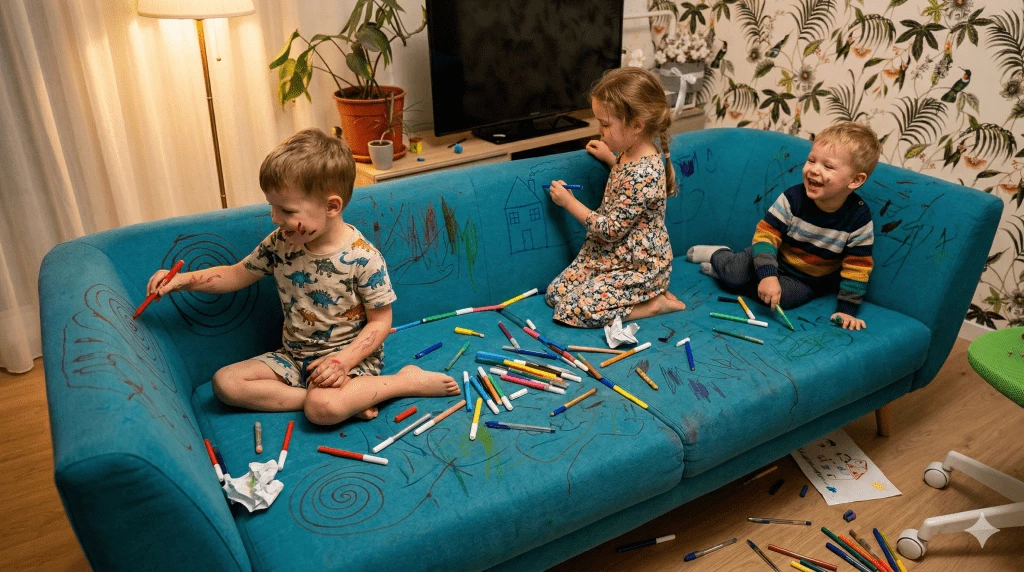
- Chewing gum, glue, paint, rust. Gum comes off. Glue is a frequent story (kids doing homework on the sofa). For every case we have a dedicated product: separately for glue, paint, rust, wine, markers.
- Wall paint after renovation. Some of it comes out well, some — sadly — is already there to stay.
- Mould. We tell clients honestly: an item with mould is better thrown away. Mould is bacteria and fungi, a health matter. We’ll remove it on the surface, but we can’t guarantee we’ve reached the full depth of the mattress (50–60 cm). It’ll look clean on the outside, but inside the mould keeps multiplying and harming health. The American chemistry manufacturer recommends the same.
Eco-chemistry: why American and odorless
We had a concept — to choose the very best in the world. So we work with the American eco-chemistry Chemspec, considered number one in the world. The US has different standards: chemistry must be tested not to cause cancer, and it’s mostly odorless.
This gives us a big advantage: our chemistry doesn’t smell, we can work without gloves, and we don’t harm the health of either our technicians or our clients. I’m allergic to chlorine myself, so the principle is simple: after us, the apartment shouldn’t smell of anything — we come to bring cleanliness and beauty, not «the smell of chemicals».
A few details people asked about on air:
- These are concentrates: a cleaning job uses only 10–15 grams. A three-litre can costs around €150, but because it’s concentrated it affects the order price only slightly — far cheaper than «odd products that both stink and harm your health».
- At first we had to invest a couple of thousand euros in chemistry. But it pays off through good reviews and clients who come back.
- Sometimes we mix products into «cocktails» — that gives a faster and better result.
Equipment: 60 kg of professional gear
The technician arrives with «60 kilograms of happiness», as we joke: a powerful extraction vacuum, two fans for drying, and a big bag of chemistry — a separate product for every stain. The extraction vacuum itself weighs about 27 kg, with separate tanks for clean and dirty water (this model holds 15 litres); you add shampoo inside, and the dirt collects in a separate tank.
Why does professional equipment matter? We often meet clients who bought a Thomas, a Kärcher for €500 or a Rainbow for €2000 at home — and «somehow it didn’t work». It comes down to the pressure (in bars) with which the cleaning agent is delivered inside, and to whether the equipment rinses not just the fabric but the foam itself. A weak vacuum will rinse the fabric — visually the sofa will look clean, but at any contact with moisture the dirt will rise back up from the foam and streaks will appear.
That’s why our technicians work with transparent nozzles — they see where the dirt is coming from and pass over a spot 3–4 times until clean water runs. Only then do they collect the moisture and set up drying.
More from the «arsenal»:
- Brushes. We spent about €500 selecting brushes. They’re colour-coded by hardness (blue is hard, yellow softer, green, red). The key is to pick a hardness that won’t scratch the furniture. We mostly work with a soft brush at high rotation speed: we stopped scrubbing by hand long ago — it’s too physically demanding — and use automated systems instead.
- The «rat» attachment. A special beating attachment for the vacuum (available on Amazon): it vibrates, lifts the pile and knocks dust out of mattresses and furniture beautifully. We especially recommend it to people with allergies — vacuum mattresses with this attachment.
- Fans. An ordinary fan costs €50–70, ours cost about €450. They produce a huge airflow and dry furniture in minutes, not days.
Drying, electricity and seasonality
The whole job, including drying, takes about an hour. The drying itself is 15–20 minutes: the goal is to drive out about 80% of the moisture so the furniture finishes drying on its own during the day. For comparison: with ordinary washing, furniture dries for 2–3 days. By evening you can already sit on the sofa.
There was a separate question about electricity on air. We plug into an ordinary outlet (no generators). One distrustful client even installed a «smart outlet» with a meter — to check «how much we’d burn». The result: cleaning a large sofa used only 1.2 kWh — that’s less than one euro. With a cleaning price of €40–60, one euro of electricity changes nothing.
And another common myth — about seasonality. Many think: «let’s do it in summer so it dries». But cleaning has no season: in summer our fan dries it, in winter the apartment heating helps as well. You can clean at any time of year.
Where our skill comes from
It’s an unusual field, so we trained seriously. At first we bought courses — Russian, as well as the most advanced English and American ones (from the chemistry manufacturers), books, and video courses. The Americans have everything thought through to the smallest detail — even an ultraviolet flashlight to spot protein stains. Then it’s trial and error: you refine the technology, choose your brushes and chemistry «cocktails».
We also have a «test» carpet — long-suffering, it’s been through everything some twenty times. On it we drew with different markers, poured coffee and checked which chemistry actually works, not just what the manufacturer claims. By now the solutions are found, so we rarely run such tests — only to show a client.
Cars and other unusual orders
To be honest, we’re not too fond of cleaning cars: it needs a sterile environment around, and specialized companies handle car interior cleaning better. We take on cars rarely — when a client is delighted with the sofa cleaning and asks us to «save» the car too. One interesting case: we cleaned the car of a man who smokes fish — the whole interior was soaked in oil and smell. We washed the foam until it was fully clean and restored the car to a new look.
Among the curiosities there was also a two-metre teddy bear («lifting its paw is hard work»), beanbag chairs with granules, and baby strollers that people sometimes bring to us «for rescue». No dirty sofa frightens us any more — on the contrary, the more interesting the case, the more beautiful the «before/after» photo.
How often to clean and what you can do yourself
Manufacturers recommend every six months — we recommend at least once a year. In families with children or pets — every 6–8 months. Regular cleaning freshens the furniture, extends its life and removes allergens and dust mites.
What you can do yourself between cleanings:
- Vacuum the furniture at least once a week — ideally with a special attachment (the «rat»). Otherwise dust gets inside, and at any contact with moisture streaks will appear.
- Spilled something (wine, tea, juice)? Don’t use household chemistry — no Fairy, no Vanish. Just take wet wipes (sold in any shop) — they absorb well. Blot fresh stains, but don’t rub.
- Leather furniture — treat it with balm every six months to a year.
- The main rule — do no harm, don’t ruin it.
How we work and how much it costs
One technician does the job, usually within about an hour — we don’t «fuss about» for two or three hours, because we bought the best equipment in the world. Before the visit we discuss the sofa type and size with the client by phone (sometimes we ask for a photo). Statistically, it works out in 95% of cases.
A few price reference points (Riga and suburbs):
- straight sofa — €45–50, corner — €48–65 depending on size, U-shaped — €65;
- leather 3-seater — from €45; chair — from €10; bed headboard — from €50;
- mattress — from €43 (double-sided cleaning +€30);
- carpet — €10–12/m² (natural — €15/m²).
Minimum order — €45. The call-out is free in Riga and suburbs up to 70 km. The price we quote in advance is final (the only possible surcharge is strong odor removal, +€5, and the technician warns you about it beforehand).
What’s important to know:
- You pay only after the result — no prepayment. Not satisfied — you don’t pay.
- Quality guarantee: if a stain remains somewhere after full drying, the technician will come back and re-clean it free of charge. We guarantee the sofa will be at least 90% cleaner.
- Express drying is included in the price; you can use the furniture the same day.
- We’ve been working since 1999 — that’s more than 25 years of experience and 12,700+ cleaned items.
🎧 Listen to the original interview
The conversation on Latvijas Radio 4, the show «Простыми словами» («In Simple Words»), 20 September 2022 (recording at 09:08; conversation in Russian).
Open the recording in the LR4 archive →
Want it just as clean?
Book professional dry cleaning of your sofa, carpet or mattress with a free call-out in Riga. You pay only after the result.
📞 +371 20226440 or message us on WhatsApp — we reply in 5–15 minutes
Order Cleaning
Free visit and estimate. Same-day results.
